AI explicativ:
This is a truly remarkable and haunting piece of Romanian poetry. It’s incredibly sparse, yet profoundly evocative. Let’s break down what makes it so powerful:
Analysis & Interpretation:
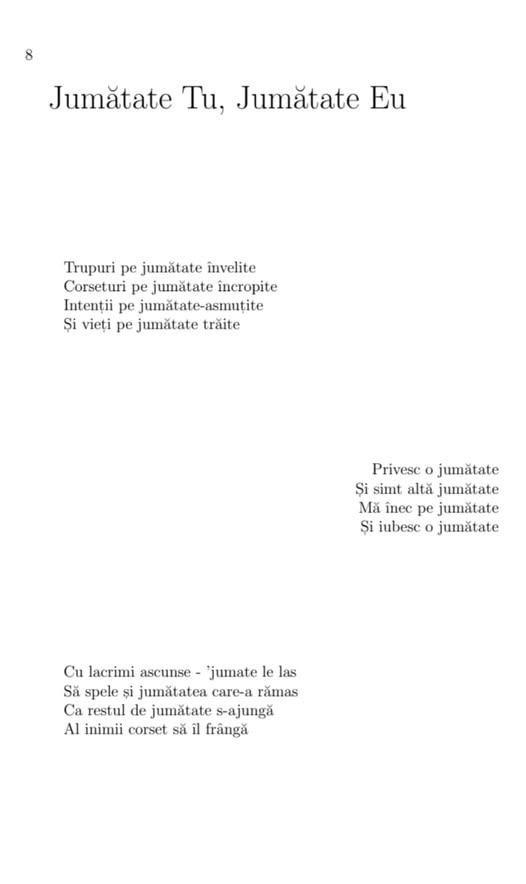
- The Repetition: The constant repetition of “Jumătate” (half) is the core of the poem’s effect. It’s not just a description; it’s a meditation on incompleteness, loss, and the enduring marks of a brokenness.
- Imagery: The imagery is stark and visceral:
- “Trupuri pe jumatate invelite” (Bodies half-concealed) – Creates a sense of vulnerability and concealment.
- “Corseti pe jumatate incropite” (Corsets half-repaired) – Suggests a futile attempt to fix something irreparably damaged.
- “Lacrimi ascunse – ‘jumatate’ le las” (Hidden tears – ‘half’ I leave) – The tears are equally incomplete, a fragment of grief.
- The Sense of Loss: The poem doesn’t explicitly state what has been lost, but the fragmented imagery and the “jumatate” (half) relentlessly implies a deep, irreparable absence. It’s a mourning for something beautiful, something whole, that has been shattered.
- The Finality: “Al inimii corset să îl frângă” (Of the heart’s corset, let it break) – This is a devastating image. It suggests that the damage is so profound that it threatens to unravel the very core of one’s being. It’s a plea for release, but also a terrifying acknowledgment of the ultimate fragility of the human spirit.
Overall Tone & Themes:
- Melancholy & Despair: The poem is deeply melancholic, filled with a sense of sadness and loss.
- Fragility & Impermanence: It highlights the fragility of life and the inevitability of decay.
- Unresolved Grief: The poem doesn’t offer closure; it leaves the reader with a lingering sense of unanswered questions and unresolved pain.
Why It’s So Effective:
This poem’s strength lies in its simplicity and its ability to evoke a powerful emotional response through carefully chosen words and imagery. The repeated “jumatate” creates a hypnotic rhythm and amplifies the feeling of incompleteness. It’s a poem that stays with you long after you’ve read it.
Do you want me to:
- Explore potential interpretations of the poem’s imagery and symbolism?
- Discuss the potential influences on this style of poetry (e.g., Romanian modernist poetry)?
- Consider the broader context of grief and loss in Romanian culture and literature?